Monday, June 25, 2012

Noah's Tears


“For surely I know the plans I have for you, says the Lord, plans for your welfare and not for harm, to give you a future with hope.” – Jeremiah 29:11

Noah and His Sisters
I have so many vivid memories from my recent trip to Zimbabwe. But I keep coming back to one story – the story of Noah and his siblings – the story that opened my eyes to the depth of the pain and grief and vulnerability of these orphans in Zimbabwe.
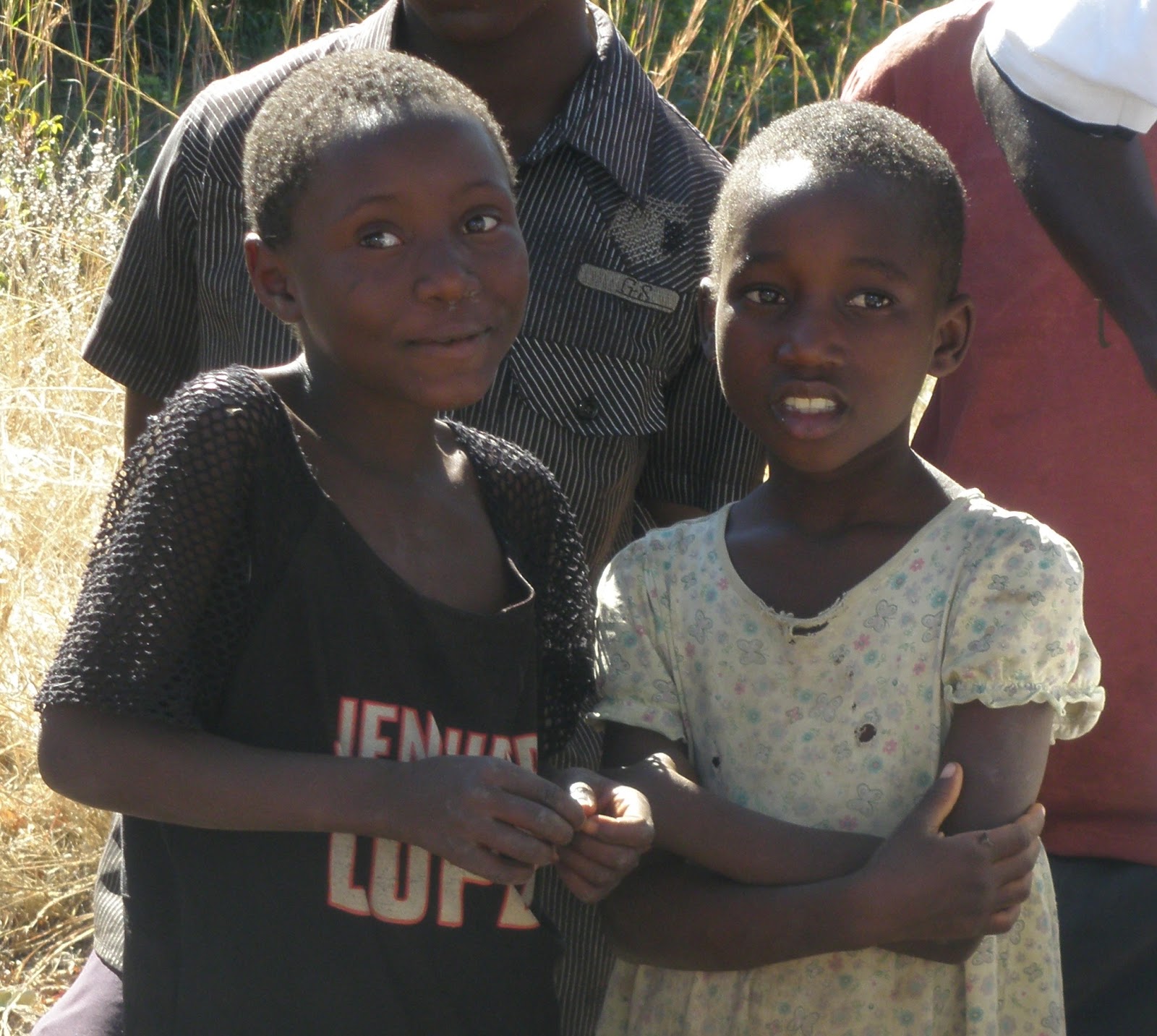
We spent the first few days visiting with orphans who had been in the ZOE Ministry empowerment program for just over a year. These children had built strong relationships within their Working Groups – mutually supportive groups of approximately 60 orphans who are like an extended family.[1]  Each family had just harvested an abundance of corn – enough to feed every mouth for a year, with some left over to sell. Beyond building relationships and finding food security, the children were developing useful business skills, finding ways to return to school, and growing in their faith. Each group we met greeted us with beautiful songs sung in harmony and each group prayed with us. We saw orphans who seemed to be well on their way to being independent and happy. 

Given the startling cultural and economic and political differences between the United States and Zimbabwe, it was easy to lose sight of the bizarre reality that the children we met were orphans – households headed by teenagers. It was easy to forget that their parents had died of HIV/AIDS, often leaving them with nothing but each other. During these first visits, I simply didn’t think to ask the hard questions.

Noah's Home
And then, after seeing so much success, we went to visit 14-year-old Noah and his 9-year-old twin siblings – newly identified orphans who were at the beginning of the empowerment journey. As we walked down the dirt path to their home I was immediately struck by their isolation: there were no other people present, no visible community, and no animals – no chickens, no goats, no dogs. Just three kids sitting in a neatly swept compound.

As Noah began to tell his story, tears ran down his face. His parents had died several years ago. His older sister left last year after she got pregnant. The past year has been incredibly hard. Some days there was absolutely nothing to eat. Some days Noah found work, but a full day’s work would barely pay enough for the three of them to have one simple meal. During the cool winter nights the three children shared one blanket on the floor. A neighbor had pity on them and gave them a 3-foot by 5-foot patch of garden to grow greens – something, but far from enough. The field next to the house remained unplowed and unplanted because Noah lacked the resources and the skills.

And tears ran down our faces as we listened to Noah tell a story of grief and isolation and fear.

The Southern Alamance Working Group:
These orphans have been together for one year.
But the full depth of Noah’s pain did not hit me that day. I kept clinging to a future with hope. The knowledge that, thanks to ZOE Ministry, one year from now Noah and his siblings will be part of an extended family of orphans. The certainty that Noah will plant his field, he will establish a garden, he will have chickens. The conviction that God has plans for Noah – plans for his welfare and not for harm. That day I walked away not fully grasping Noah’s tears.

Last week I ran into a friend who made an observation about a mutual friend: “I notice that you two don’t hang out any more.” Before any words could come out of my mouth, tears sprung from my eyes. Grief and pain that I thought I had carefully concealed bubbled up to the surface, unbidden. And in that moment, as I tried to regain my composure, I thought of Noah’s tears.

Healing takes time. Next year when a group from Southern Alamance visits Noah, they will see smiles instead of tears. They will see food instead of an empty pot. They will see a field planted with corn instead of wild grass. They will see Noah surrounded by his new extended family singing songs and praying together.  What they may not see is the grief and pain that remain concealed just below the surface. Healing takes time.

I don’t doubt for a minute that the smiles on the faces of the orphans who have been in the program for a year are real. ZOE Ministry has given them a future with hope. But the staggering reality of their loss is also real. The obstacles they face each day are almost inconceivable. And there are so many orphans who are still incredibly vulnerable. They confront the reality of hunger and fear and grief and isolation every day. Their tears are very real.

Today I learned that Noah has run away from home, leaving his siblings alone. Apparently someone has been bullying him. While I stand firm in the conviction that God has a plan for Noah, a plan for his welfare and not for harm, I also believe Noah’s story is a call to action. While the social workers in Zimbabwe are looking for Noah, we can pray for Noah and for other orphans like him. While ZOE Ministry continues to empower orphans across Africa, we can find ways to empower the least and the last and the lost in our own communities. I truly believe God is making all things new. With God’s help, Noah’s tears will never have the final word.


[1] For more on ZOE’s empowerment program and working groups, see http://www.zoeministry.org/about/orphan-empowerment-program/.

Tuesday, June 19, 2012

Feet


“Then Jesus poured water into a basin and began to wash the disciples’ feet and to wipe them with the towel that was tied around him.” – John 13:5

The first thing I did when I got home from Zimbabwe was pick up my dogs and take them to the Eno River for a walk. I suppose that was a little crazy, as 24+ hours earlier I had been riding an elephant at the Imiri Safari Ranch outside of Harare, and we had gone straight from the elephant to the airport.  Three planes and 20+ hours later I landed at RDU.  And just over an hour after that I was standing in the Eno River.

As the water ran over my tired, swollen, filthy feet I could feel the dust of Zimbabwe wash away. I had spent the entire trip in my Chaco’s – I’ve got the tan lines on my feet to prove it! 

I discovered while I was there why foot washing is both necessary and menial work. There was dust everywhere during the dry season. By the end of the day my feet were caked with dust. Before dinner I would wash my feet in soapy water, having to scrub between my toes and around my nails just to get the dust off.  When I had the energy, I washed my shoes as well.  How little we have to think about our feet here in the US where we have close-toed shoes and paved roads and plenty of water.

Feet.  So many of the orphans we met did not have shoes on. It made me wonder about their water supplies: Where did they wash their feet?  Where did they get water to drink? The orphans often had to walk good distances to find potable water – and even then it had to be boiled before they could drink it. No wonder hygiene is one of the first things ZOE Ministry teaches.  Looking at their bare feet and their filthy flip-flops, I wondered how many of the orphans had shoes for school. You can’t go to school without a school uniform, including shoes, and shoes are expensive. And what about disease? Feet. We don’t often think about our feet.

I love being barefoot. It is one of the reasons I prefer sandals to closed-toe shoes. It is one of the blessings of my church and parsonage being less than 50 feet apart. But being shoeless is a choice I make; wearing sandals is my preference.  What a privilege!

Imagine having no shoes when the roads are scalding hot from the sun. Imagine having no shoes on those days when it is really cold.  Imagine having no shoes when it is raining and the paths have turned into mud. Imagine having no shoes and wanting so badly to go to school, even walking several miles in bare feet to get to school in the hopes of learning something anyway. And imagine having no water to spare at the end of the day to wash your dust-covered or mud-caked feet.

And Jesus poured water into a basin and began to wash his disciples’ feet, setting an example for us, that we should also wash one anothers feet. As I stood in the Eno River that day, letting the flowing water wash my feet, I gave thanks to God for ZOE Ministry. ZOE doesn’t give the orphans shoes like Soles 4 Souls. ZOE doesn’t buy school uniforms for orphans like Zimbabwe Orphan Care. What ZOE Ministy does is so much more powerful: ZOE empowers the orphans to provide for themselves by teaching hygiene and farming and small business skills. ZOE restores a sense of community and cultivates a faith in Jesus Christ.  ZOE Ministry teaches orphans that they (and we!) should also wash one another’s feet.

Tuesday, October 18, 2011

Here

I can’t sleep. I’ve left the warmth of my bed in the wee hours of the morning, leaving the cat curled up in her usual spot on the bed. Neither dog moves as I head for the kitchen. Hot chocolate. That will do.

Sitting on the front porch with my feet curled up under me, I warm my hands with the mug of hot chocolate. I’m struck by the darkness. The sliver of moon is casting eerie shadows. The single streetlight shines in the empty church lot, revealing a lonely soccer ball taking up its own parking space. There’s something strangely comforting about the darkness. As my eyes adjust I am able to make out the steeple on the church with the lopsided cross on top, and I smile. “Even the darkness is not dark to you, Lord; for night is as bright as day.” The hot chocolate calms me, but I’m not ready to return to bed. And so I sit.

As the cool of the night seeps into my bones I become aware of the sheer sound of silence. It is too late for crickets and too early for birds. Not a single car has gone by. The goats and chickens are all quiet. Even the river is noiseless tonight. And for a moment – just a moment! – the clamor in my head is stilled.

And then the beautiful soprano line from Mendelssohn’s Elijah fills my head: “And in that still voice onward came the Lord...” Music has a way of speaking to me when nothing else will. The Lord was not in the mighty wind that split mountains; the Lord was not in the earthquake that broke rocks into pieces; the Lord was not in the fire. No, the Lord spoke to Elijah in the sound of sheer silence, asking, “What are you doing here?”

What am I doing here?

I wonder: God, what do you mean by here?  Here as in Saxapahaw?  Here as in ministry? Here as in the front porch in the wee hours of the morning?

And God laughs: Yes. All of the above. Here.

I think of Elijah’s response: “I have been very zealous for the Lord.” The Israelites have broken your covenant; the people have turned away from you again and again. I’m worried. I’m worn out. My heart is broken.

And then I laugh, because God’s response to Elijah was simply, “Go.”

Trust Me, and go back to bed, for the dawn will come, bringing bright sunshine and chirping birds and barking dogs and busy people traveling to and fro. The dawn will come, bringing new opportunities and renewed hope and moments of sheer joy. The dawn will come, and people need to know that even during their darkest hour I AM here.

Friday, August 12, 2011

The Dream


The narrow path I had been walking along led to a door.  When I noticed the door I stopped and looked back along the path I had been following.  As I realized the path was straight and narrow excitement welled up inside of me.  Certainly the door would lead to the kingdom of heaven!  I began to imagine what I would find on the other side of the door once I reached it.  I envisioned lush greenery, trees covered with the most perfect fruit, streams of crystal clear cool water, a gentle breeze.  I began to walk more quickly, eager to reach the door – eager to open the door to this whole new world.  When I reached the door I paused, taking a deep breath before opening it.  Then, filled with anticipation, I quickly pushed the door open. 

It is hard to describe the next few moments.  I was stunned by what I saw.  Nothing looked the way I expected it to look.  There were no trees – actually there was no greenery at all.  And no evidence of water.  As I stood in that doorway I looked out over a barren desert that had been parched by the scorching sun and hot wind.  Tears sprung to my eyes as I stood there, utterly perplexed.  How could this be?  Didn’t scripture say that the way that leads to life is straight and narrow?  Yet there was no life on the other side of this door!  What happened?

Confused and dismayed, I looked back along the path that had led to the door.  From this new perspective I realized that the path was not as straight as it had originally seemed.  Neither was it particularly narrow.  I began to stumble back along the path, seeking to understand how the path I had followed had led to such a desolate place.  I had not gone far before I realized that there were numerous forks in the path – forks I had not noticed before.  I came to one fork and turned around, looking down the two paths.  The paths looked almost identical.  They both appeared straight and narrow at first glance.  But the one I had chosen was wider and better traveled, and it curved ahead – perhaps at another fork.

I kept traveling back along my path, stopping at each fork.  It was clear that these forks marked small decisions – seemingly insignificant decisions – I had made during my life.  At one fork I had chosen to spend an evening with one friend instead of another, knowing time with the one friend would be more fun.  At another fork I had chosen to eat some food that was not good for me, rationalizing that a little bit would not hurt.  At another fork I had skipped a meeting I should have attended because I was tired (and didn’t really want to go anyway).  At another fork I had ignored an uneasy feeling in the pit of my stomach because I was enjoying spending time with a person. 

Each fork marked a small decision – one I never imagined would make any difference in the grand scheme of my life.  And yet, at so many of these small forks I had chosen the wider path, the easier path, the better traveled path.  I had inadvertently chosen the path that led to death.

At that moment I woke up from my dream, sitting straight up in bed.  How was this possible?  What had I done?  How could so many seemingly insignificant decisions have caused so much damage?  In that fog between dreaming and wakefulness I cried out in dismay.

Desmond Tutu writes, “The Buddhist practice of mindfulness and the daily examen of Ignatian spirituality point to the same end: when we pay attention, it is possible to halt evil in its tracks.  Paying attention also helps us to see how easy it is to become inured to the proliferation of evil.  Evil does not sweep in like a tsunami; it bleeds into the fabric of life, washing out the joy and staining the beauty.  Choosing wrong is learned through a series of small decisions.  Little failures become ingrained through repetition.  The small faults, unchecked, open the way for all the vileness of which we are capable.”[1]

While Archbishop Tutu is talking about the sin of apartheid, an evil that bled into the very fabric of life in South Africa, he speaks a truth that is relevant to all of us: Choosing wrong is learned through a series of small decisions.  But there is a deeper truth: Through Jesus Christ we can learn to choose the good.  Through mindfulness and repetition, goodness can infiltrate the fabric of life, filling it with joy and revealing the depth of its beauty.

As I became fully alert on that dark night, I remembered the awesome God I serve – a God of compassion and forgiveness – a God of second and third and fourth chances.  While the path in my dream may have led to the door of hell and death, God was showing me another way.  There is a path that leads to the kingdom of love and life.  It is a narrow path.  It is not as heavily traveled as the other paths.  And yet, it is clearly available to all.  This path is followed by those who pay attention to the signs – those who listen to the nudgings of the Holy Spirit – those who are mindful of God’s grace at work, even in the midst of the smallest decisions.  With God’s help, we can learn to choose the path of life.

In the darkness of that night, as I prayed for forgiveness and mindfulness, I began to sing:

Goodness is stronger than evil;
Love is stronger than hate;
Light is stronger than darkness;
Life is stronger than death.
Victory is ours, Victory is ours,
Through Him who loved us;
Victory is ours, Victory is ours,
Through Him who loved us.[2]


[1] Desmond Tutu, Made for Goodness: And Why This Makes All the Difference (New York: Harper Collins, 2010), 95.
[2] The Faith We Sing (Nashville: Abingdon Press, 2000), 2219.  From An African Prayer Book, by Desmond Tutu.

Friday, July 8, 2011

¡Soy hispano!


According to the US government definition, I can answer the question “Are you  Hispanic/Latino” affirmatively![1]  I am Hispanic because I trace my origin to Bogota, Colombia.  In this case, “origin” is understood as country of birth and Colombia is in South America.[2]  At first glance, it seems I have misrepresented myself for the past 40+ years, as I have never considered myself to be of Hispanic origin.  White, Anglo-Saxon, Protestant? Yes. Hispanic? No.  But then, the US Census Bureau has simplified the definition, since determining whether a person is of Hispanic origin is quite complicated: simply, you are of Hispanic origin if you say you are.[3]  So if I want to say I am of Hispanic origin, I can.

Sue in Mexico City, 1968.
While calling myself Hispanic may seem absurd, the more I have reflected on this the more sense it makes for me to do so.  After all, I share many characteristics with the Hispanic communities in North Carolina. I was born in a Latin American country. I came to the United States from Mexico, like 63% of the Hispanics in this state.[4] I was in the fourth grade when my family moved to the United States from Mexico City, where I had lived for almost seven years. Like so many of the people coming to the United States from Mexico, we moved here because my father was offered a better job. In his case, it was a promotion within the same company. Nevertheless, it was a better job. Like so many Hispanic children, I did not choose to come to the United States. I came to this country because my parents came to this country. Finally, like 55% of the Hispanics in North Carolina, I have legal documentation of my right to be here.[5] I am a legal alien; I carry a green card.

Of course, most similarities end there. I have grown up with privilege. I’ve never been discriminated against because of the color of my skin. I’ve gone to the best schools, never wondering whether my legal status might keep me from attending.[6] No one has ever asked me about my legal status in a job interview or at a roadside checkpoint. While there have been times when I have been afraid, I have never lived in fear. My white skin and my fluency in English have given me so many opportunities – opportunities I have simply taken for granted.[7]   

So what does it mean for me to claim my Hispanic origin? It means that stereotypes of what it means to be Hispanic/Latino are just that – stereotypes. Not all Hispanics are brown-skinned, Spanish-speaking, and undocumented. As a matter of fact, some are white and some are black; some are third and fourth generation American citizens; some have never spoken any language except English. In other words, there is as much diversity among people who are Hispanic as there is more generally in the American population. Stereotypes are dangerous and discriminatory; stereotyping Hispanics is damaging and divisive to our entire community. And yet, it happens all the time.

This past year I have spent a great deal of time learning about the challenges faced by the Hispanic community in Alamance county, particularly as a result of the 287(g) program.[8]  The Sheriff’s department has partnered with ICE to implement this program – a program that is intended to facilitate the removal from this country of dangerous criminals who are undocumented.  But this county has chosen to use the program to attempt to remove all Hispanics who are undocumented.  In the words of our county commissioner, Tim Sutton, “287(g) deters local crime by illegal aliens. But that’s not the only thing I’m after. I want illegal aliens, to be honest with you, out of here.”[9] I wonder if Mr. Sutton has truly thought about the impact of his statement.  What about those who came to the United States as children? Those who have been here 20+ years? Those who know no other home except North Carolina? Out of here to where, Mr. Sutton?

One problem with the 287(g) program as it is implemented in Alamance County is that it leaves all those who are brown-skinned, regardless of their legal status, living in fear. This type of racial profiling is crippling our community. Claiming my Hispanic origin compels me to stand with my Hispanic/Latino brothers and sisters against the fear tactics imposed by those in power, especially here in Alamance County. Claiming my Hispanic origin compels me to speak out against the injustices experienced by my Hispanic brothers and sisters.

Compels. That is a strong word. I have been motivated to pray for and with my Hispanic brothers and sisters for years.  From trying to teach the language of Chemistry in English to youth who only spoke Spanish, to entering into the lives of and worshipping with the Hispanic community at Reconciliation UMC in Durham, I have been motivated to pray. I have been inspired by the friendships I have formed and the reading I have done to do more for my brothers and sisters – but I have not acted. Today I am compelled to stand with this community against the powers that be. While I have no idea what this will look like, may God open doors that enable me to do this faithfully!


[1] The term "Hispanic" refers to persons who trace their origin or descent to Mexico, Puerto Rico, Cuba, Central and South America, and other Spanish cultures. http://www.whitehouse.gov/omb/fedreg_1997standards
[2] Origin can be viewed as the heritage, nationality group, lineage, or country of birth of the person or the person's parents or ancestors before their arrival in the United States. http://latinostories.com/Latino_Facts_and_Statistics/Census_Stats_Latinos/Definition_of_Hispanic_Origin.htm
[5] In NC, an estimated 41% of Latinos are native-born US citizens.  Those who are naturalized citizens or have visas make up 13.6% of the total Latino population in NC.  The remaining 45% lack legal immigration status.  Hannah Gill, The Latino Migration Experience in North Carolina, page 5.
[6]“NC Coalition for Justice for Immigrants” website, http://www.welcometheimmigrant.org/legislative-updates, has information on legislation in NC about denying post-secondary education to undocumented immigrants. House Bill 11 can be found at the NC General Assembly site at http://www.ncleg.net/gascripts/BillLookUp/BillLookUp.pl?Session=2011%20%20&BillID=h11.
[7] See Peggy McIntosh’s article, White Privilege: Unpacking the Invisible Knapsack.
[8] Go to the Immigration and Customs Enforcement website to learn more: http://www.ice.gov/287g/
[9] The 287(g) Program: Costs and Consequences, page 10, from the Institute for Study of the Americas at UNC-Chapel Hill. Download at: isa.unc.edu/migration/287g_report_final.pdf

Monday, June 27, 2011

Durham, Sweet Durham


The sun was just setting as we walked out of Torero’s in downtown Durham last Friday.  The cumulonimbus clouds billowed on the skyline, brightly colored with pink and purple and orange hues against the startling Duke blue of the sky.  A large group of well-dressed young women stood on the sidewalk, talking and laughing, creating an obstacle course for us to get through. A freight train traveled toward Raleigh with car after car of goods.  Boxcars followed by tankers, the inevitable graffiti coloring the sides; the regular clickety-clack of the wheels creating a steady din in the background.  The road was busy, the parking lot full, and the sound of people filled the air.  It was a magical moment for this city girl who now lives in the country.  I delighted in the sights and sounds – truly an assault on the senses.  No words can capture the beauty of that moment.

As I took in this scene I exclaimed, “I love Durham!”  In that moment, memories came crashing in on me, and I realized I’m not just a city girl, I’m a Durham city girl.  As I noticed Liggett Myers on one side I vividly remembered the wonderfully sweet and pungent smell of tobacco filling the air.  Years ago, my mom and I sat talking on the East Campus wall just a few blocks away on an equally beautiful night when that smell of tobacco was particularly strong; that was the night my mom became my friend.  Looking toward Brightleaf Square I was flooded by more memories.  Pizza and more pizza at Satisfaction across the years – such good pizza, such yummy fried mushrooms, such wonderful company!  And more recently, I recall a Disciple Bible Study at El Rodeo one beautiful spring evening.   There are so many memories of good food, live music, people dancing, deep conversations, and loads of fun with so many friends across time.  

After leaving Torero’s, my friend and I headed to East Campus for an evening stroll.  Large trees, empty benches, lush grass, beautiful flowers – it’s such a pretty campus.  And it is so quiet in the summer time!  As we walked, I recalled so many walks with dogs – Helmunth jumping the wall and dashing across Main Street, Jeepers disappearing late one night only to reappear on our doorsteps back home.  Miles and miles of walking that wall alone, with dogs, with friends...  It was along that wall that I experienced my first really passionate kiss so many years ago.  Of course, I’ll never forget regularly putting a penny in the Sower’s hand for good luck.

Stepping out of Torero’s on a Friday night seems like such an ordinary thing to do, and yet on this night the sights and the sounds triggered memory upon memory.  Maybe it is a sign that I’m getting old.  On the other hand, what an extraordinary privilege to be able to visit these few blocks of downtown Durham that hold almost thirty years of memories!  And what a gift to remember so many good friends across time – friends who have made my life rich with beauty and joy and love – a richness money cannot buy.

The fact that I am a Durham city girl at heart has more to do with the people whose lives have intersected mine in Durham than with the city itself – friends who have helped to create so many magical moments.  Thanks be to God for this little corner of heaven called Durham, and for the friends who have made Durham so special to me.  What a gift to be able to say, “I’m from Durham!”

Monday, May 30, 2011

A First Year Pastor’s Top Ten Gleanings

It has been almost one year since I became the pastor at Saxapahaw United Methodist Church.  While my years of teaching high school at Northern Durham, my wonderful seminary education at Duke Divinity, and my invaluable experience on the pastoral staff at Reconciliation UMC prepared me well, the learning curve has been steep during this first year of ministry.  Today I thought I’d reflect on what I’ve learned so far.  Here are my top ten gleanings:

1.     The weekly task of preaching is a gift.  The hours spent preparing – reading, praying, pondering, exploring, and finally writing – create a rhythm in my week that grounds me in God’s Word.  That is pure gift. 

2.     The weekly task of preaching is a challenge.  Sunday comes every seven days, whether I am ready for it or not.  Unlike teaching a lesson where there is a clear objective, the objective of preaching comes from studying God’s Word and knowing God’s people.  I recognize my utter dependence on God on those weeks when I’m sitting in front of my computer on a Saturday morning and still have no idea what Word to bring to God’s people.

3.     Praying for the people is utterly essential.  Each week, in addition to spontaneous prayers, I pray through the church directory; mine is filled with notes and names that I have added.  These prayers connect me to the congregation in a way that nothing else can; they are the foundation for building strong relationships.

4.     Conflict is inevitable. 

5.     Time with the congregation is indispensable.  From visiting the sick and those who are grieving, to showing up at birthday parties and games, spending time listening and laughing and praying together is invaluable.

6.     Time with friends and colleagues is important for a balanced life.  Whether it is time with my accountability group, my friends, my mentors, or other pastors, that time is so important to help me keep things in perspective.

7.     Time in study and reflection beyond preparation for worship and Sunday school is absolutely necessary.  From daily devotions to close readings of theology books to watching movies and reading novels, this time spent learning about God and God’s people has a way of grounding me and keeping things real.

8.     There is never enough time.  

9.     The people who make up the church are extraordinary.  They love one another, through good times and tough times.  They freely give of their time to the church – teaching and leading, planning and visioning, cleaning and mowing – on top of the many commitments of a busy life.  And even more astonishing, they support the church financially, paying me to do the things I love most.  The people of God are faithful and good and generous and loving.  They are extraordinary.

10. It isn’t about me.  At the end of the day, it isn’t about what I’ve done or who I’ve visited.  God has this uncanny ability to show up and give us a glimpse of the Kingdom in the midst of our most mundane activities and during our most profound moments of worship.  At the end of the day, there is nothing to do but give thanks to God for this gift called ministry.