Friday, January 8, 2016

The World In Which I Live


Consumerism, affluenza, greed...
Anger, grudges, fear...
Selfishness, loneliness, barrenness...
Hunger, thirst, longing...
Pain; deep, searing pain...

The truth is that this is the world in which I live.

In this world husbands cheat on their wives.
In this world children are sexually abused.
In this world mothers lose their babies.
In this world loved ones die of cancer.
In this world friends are addicted.

Suffering is all too real.

It is easy to get trapped
in the nets of this world.
It is easy to get lost
            in the darkness.

There must be more to this world...
Lord, please let there be more to this world!

If this is all there is to this world
            I surely will die.

Jesus Christ came into this world:
Jesus, the Light of the World.
Jesus, the son of Mary.
Jesus, the Redeemer.

The truth is that Jesus changed everything about this world.

The blind can see, the deaf can hear,
the lame can leap for joy.
The lost are found, the hungry are fed,
            the imprisoned are set free.

This is also the world in which I live –
            a world full of life!

And I get to choose...
            the darkness or
                        the light,
            death, or
                        life.

I choose the light.
I choose life.
I choose Jesus Christ.

In this world the woman caught in the act of adultery
            is set free.
                        “Go, and sin no more.”
In this world the thief on the cross next to Jesus
            is set free.
                        “Today you will be with me in paradise.”

In this world, broken people stumble their way
            to the foot of the cross
and experience forgiveness.
In this world, hungry people find their way
            to the Lord’s Table
                        and experience mercy.
In this world, lonely people find their way
            to the community of faith
                        and experience communion.
In this world, people from all walks of life
            find their way to Jesus
and experience grace.

You ask about the world in which I live?
            I live in the world of light.
            I live with the Good News of Jesus.
            I live as part of the body of Christ.

I love this world –
this world that is overwhelmed with suffering,
this world that is drenched in love,
            this world that is overcome through compassion.

You ask about the world in which I live –
I live in this world
            in all it’s beauty and brokenness.
I live in this world
            full of saints and sinners.

And I wouldn’t trade the gift of this world – God’s world –
            for anything.

Tuesday, July 23, 2013

Weeds


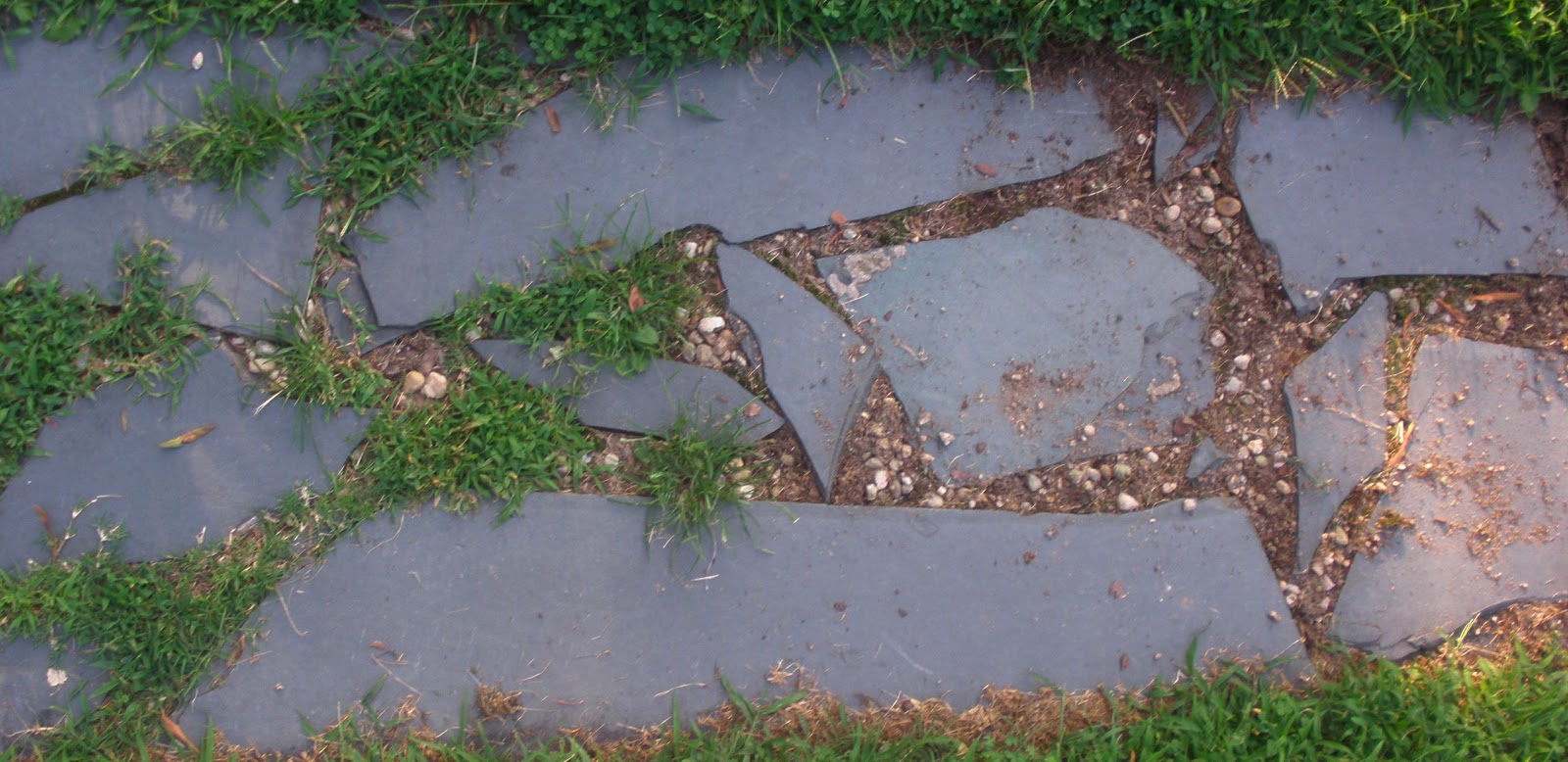
I’ve often wondered who had the brilliant idea of putting in a slate walkway to the parsonage. While it is attractive, it requires constant maintenance. This is because the most fertile soil in all of Alamance County is found in the cracks between the slates, and the weeds spring up overnight. Seriously!

Recently I have found myself thanking God for the person who had the brilliant idea of putting in a slate walkway to the parsonage. Clearly that person understood stress and the need for activities that provide stress relief. That walkway is a gift from God!

When I find myself in the midst of a stressful phone conversation, I step outside and do some weeding while I talk. As I pull and tug at the weeds that seem to have a tenacious hold on the walkway, I find I am able to relax, push beyond the stressor, and get to the root of the matter. Difficult phone conversations are always better when I’m pulling weeds.

When I find myself wrestling with a challenging passage of scripture, I take a break and sit in the middle of the walkway digging my nails into the beautiful black soil that holds these weeds, prying the weeds out one at a time. And somehow God speaks as my nails get dirty and the walkway gets clean. And the scripture once again becomes holy.

Today at high noon in the 90-degree heat I found myself sitting on the hot slate pulling the weeds and then carefully putting the dirt that clung to the roots back into the cracks. Only minutes before, the incredible stress of ministry had me pulling my hair out. And then I remembered the weeds. It is always better to pull weeds.  It was too hot to be out there for long, but those few minutes in the blazing heat gave me some much needed perspective.

Much like weeds, stress is inevitable. Especially in fertile soil. God has created these perfect conditions for growth – rich soil, warm sunshine, plenty of rain. Of course the weeds are going to grow! But these conditions are also ideal for growing the things that are of God. A food ministry that is flourishing. A day care that will soon be filled with noisy, wonderful children. A church overflowing with incredible and faithful people. And with each weed pulled the stress melts away. And the beauty of this ministry is boldly revealed. And I thank God for the person who had the brilliant idea of putting in a slate walkway to the parsonage.


Thursday, May 9, 2013

Good Is Good Enough


I am not a perfectionist. But I do like to see a job well done. Recently, in an email exchange with a friend I was reminded, “Don’t let the perfect be the enemy of the good.” Of course this led me to wonder if I was actually trying to be a perfectionist, or if I was just trying to be a good steward of my resources. I can certainly understand, by the intensity of my email, that I was pushing to get it right. The truth is, my goal wasn’t perfection. What I wanted was for my decisions to be thoughtful and faithful. I wanted to make good decisions.

I love the proverb: “Don’t let the perfect be the enemy of the good.” Striving for perfection can actually hijack a project. Trying to get every detail just right can prove to be impossible, and a great project can fall apart before it ever gets started. But more importantly “good” is actually a good goal, theologically speaking. In the beginning when God created the heavens and the earth, each day of creation concluded with “And God saw that it was good.” Not perfect. Good. And better than good in God’s eyes is “very good.”

So often we strive for great or wonderful or perfect instead of good. There’s this sense that “good” isn’t good enough. But there’s something about goodness – somehow it speaks of beauty and simplicity and harmony and integrity. Goodness isn’t about competition or hierarchies. Goodness isn’t about perfection. Goodness is somehow tied to faithfulness. And goodness, not greatness or perfection, is a fruit of the Spirit (see Galatians 5:22, NIV). Clearly, “good” is pleasing to God.

Interestingly, on the day before this email exchange I heard Greg Jones speak at Duke Divinity School on Resurrecting Excellence.  As he spoke of leading the church in the 21st century, he made the comment, “Beware of mediocrity masquerading as faithfulness.”  Another proverb. I think we fall into this trap too often – often unawares.  Consider those times when we claim we are being good stewards of our resources and thus we are being faithful, when in fact we are afraid of taking a risk or we are afraid of failing. We claim that what we are doing is good, when the truth is that we don’t want to step on toes, offend anyone, or move out of our own comfort zones. At those times we settle – yes, settle! – for the status quo rather than pushing for that which is truly good. We settle for mediocrity and call it faithfulness. When in fact it is neither faithful nor good.

Perfection is often impossible. Mediocrity is often too easy. Yet just like the three bears and their porridge, there’s that third option that is just right: goodness.  Don’t let the perfect be the enemy of the good. Beware of mediocrity masquerading as faithfulness. And from the book of Proverbs: “Those who plan good find loyalty and faithfulness” (14:22b). So why don't we strive to do good?

Thursday, April 25, 2013

Energy


I love Einstein’s equation, E = mc2. Even as a pastor, the truth of this equation resonates with me. Somehow, in some mysterious way we don’t fully understand, energy and matter are directly related. Energy and matter are intimately tied to one another.

Of course, I’ve grown up experiencing this tie on one of my favorite shows, Star Trek. The idea behind beaming technology (Beam me up, Scotty!) is simply an example of this equation. You turn matter into an energy wave at one location and the energy wave travels to a new location (which is easy for a wave to do quickly) and there it is turned back into matter. Even in the non-science fiction world this makes a certain level of sense, since matter and energy are directly related. (It really isn’t that far fetched!) In other words, matter and energy are interchangeable.

So in the beginning when God created the heavens and the earth, we say God created out of nothing. The earth was a formless void and darkness covered the face of the deep – there was nothing. But God, who is pure energy – the God who is light and life – the God of love – created matter. God gave form and substance to the universe. God created light and land, plants and animals, galaxies and gravity, you and me. God created. Whether we call it the Big Bang or speak in terms of Genesis 1, in the beginning God’s divine energy was given form and God created. We are God’s creation.

And as God’s creation we are so clearly made up of matter – of atoms and molecules formed into cells and organs. Matter that has been given life. God has given us life. Unlike a rock or other inanimate object, God has not only created us, but given us life. And in some way that we don’t fully understand, the life God has given us – that spirit God has breathed into us – is intimately tied to the divine, creative energy of God.

As a Christian, I call that divine, creative energy the Holy Spirit. The Star Wars fans of the world call it The Force. Some might call it intuition or a sixth sense. Some call it love. I’m sure there are other ways of identifying this energy of which I am unaware. Most of us know deep in the core of our being that there’s more to the world than meets the eye – we’ve experienced this “energy” in our lives whether we are “religious” or not.

Two thousand years ago God did something new. God poured divine energy into His Son, God with us. For just over 30 years this man Jesus walked the earth. He was born in Bethlehem and grew up in Nazareth, a Jew among Jews, but also the great I AM. Divine energy made flesh in a new way – God incarnate – different from all other humans and yet still very much human. No wonder the woman with hemorrhages touched his robe and was healed. She sensed Jesus’ divine energy even before she touched him. And Jesus was aware that power had gone forth from him when she touched him (Mark 5:30). Divine energy.

And when the Holy Spirit was poured out at Pentecost the disciples and all those gathered together experienced a wind from God and tongues of fire (Acts 2). They experienced the divine energy of the Holy Spirit – a unifying energy that empowered them to do something new.

Today we experience that divine energy in so many different ways. A conversation with a friend that is filled with grace, with resonances, with peace. A beautiful sunset that deeply touches our spirit. God’s Word speaking a truth that enriches and empowers us. The Holy Spirit blowing through our church, moving us in mysterious and amazing ways.  That energy has the power to bind us together – weaving the rich tapestry of our diversity into something beautiful. That energy has the power to heal, restore, transform, make new. That energy is the source of all our being – the Alpha and the Omega – the power of resurrection.

We know it when we experience it. And we can all experience it, for this energy is not meant to be contained. I experience this energy as the Holy Spirit of God, an extraordinary gift. How do you experience this energy?

No matter what we call this divine energy, I suspect we all recognize it at something mysterious and beautiful and perfect. Perhaps, in some odd and inexplicable way, E = mc2 is just another way of saying “God with us.”

Thursday, November 29, 2012

Hunger


If eradicating hunger was easy, no one would be hungry.

Putting an end to hunger is not easy!

When we are asked to make a commitment to give of our time,
we are quick to point out that we must work to put food on our own tables.
We don’t have time to spare.

When we are asked to give financially,
we talk about how stretched we already feel.
We don’t have money to spare.

When we are asked to stretch, to sacrifice, to go the extra mile,
we say we give generously – but often we barely feel the pinch.
We are reluctant to do without.

When we are asked to pray, we say we will,
but with no names and faces to pray for we quickly lose sight of that promise.
We don’t know the hungry in our communities.

Too often we overlook the poverty in our communities,
seeing instead those who have more than we do.

Too often we are quick to point out the faults of the hungry,
wondering why they don’t get a (better) job or plant a garden
instead of watching TV all day.

Too often we see the problem of hunger and poverty
and either ignore it or decide that it is too big
for any one person to actually make a difference.

Too often we assume someone else will help since we don’t see how we can.

Putting an end to hunger is not easy!

If eradicating hunger was painless, no one would be hungry.

Jesus ate with sinners.

Jesus fed five thousand hungry people with five loaves and two fishes.

Jesus gave the woman at the well living water;
water that gushes up to eternal life.

Jesus broke bread with his disciples that last Passover,
saying “This is my body, given for you.”

Jesus taught us to follow his example;
to go and do likewise.

So why do we keep making excuses? Why do we keep pointing fingers? 

Why are we reluctant to give of our time and our money and our lives?

Because nothing about eradicating hunger is easy or painless.

But everything about putting an end to hunger is faithful to the gospel of Jesus Christ.

Saturday, November 3, 2012

Looking For Hope


There is something about hope. It is always forward-looking, anticipating that things will not stay the way they are, that life will get easier, that there is more to our daily existence than what we see right now.  In hope we anticipate a day when our hearts will be filled with joy; we expect to meet Jesus.

Paul writes in Romans 4 of Abraham: “Hoping against hope, he believed that he would become ‘the father of many nations,’ according to what was said, ‘So numerous shall your descendants be.’ He did not weaken in faith when he considered his own body, which was already as good as dead... No distrust made him waver concerning the promise of God” (v. 18-20).

Abraham was almost one hundred years old and his wife, Sarah, was ninety and barren. And yet the promise of God filled him with hope – he would be the father of many nations.

Where did Abraham find that hope? Paul points to Abraham’s faith in the living God. The God of infinite possibility; the Father who raised Jesus from the dead (!); the God whose love has been poured into our hearts through the Holy Spirit; the Almighty One who promises that we have been justified through faith, freely given the peace of our Lord Jesus Christ, and obtained access to God’s abundant grace (see Romans 5:1-5).  

There’s something about hope. I saw it in the eyes of the children in Mexico. When we were in Huitzapula we traveled to a remote village – a mission of the already remote town of Huitzapula. When we got there we discovered that everyone had headed into town for the day, except these three children. While they were too shy to come over to us, we had brought fruit for the community.  We placed some in the grass for them to come get, and they received it gratefully.  

The church in this village had been destroyed in a storm, the few houses were in disrepair, the children had been left alone. At first glance the situation felt hopeless, but the people in these mountain villages radiated hope. In the other villages around Huitzapula, the moment we arrived the people left their work to stream to a common gathering place to praise God with us through song and prayer and reading and proclaiming God’s word. It was beautiful. Astonishing. So different from here.


Zimbabwe was no different. Even the ZOE orphans who had just entered the program radiated hope. The children in this picture are cousins who lost their parents to HIV/AIDS and now live with their grandparents in a place that would have been inaccessible by vehicle in the rainy season. Their grandfather is blind and their grandmother has severe cataracts. Faith, the oldest of the cousins, is sixteen and she is the primary caregiver. As we listened to a story that brought tears to our eyes, and as we watched the weight of grief nearly overwhelm Faith and her grandmother, there was still this sense of hope: “Things will get better. We will have enough to eat one of these days. God will not abandon us. And at least for right now we have a roof over our heads. At least we have each other.”

Why is it that we so often get trapped in a sense of hopelessness?  Why do we look at our situation and think, “Things will never get better”? Why do we have such a hard time seeing God at work in our lives?

Jesus tells us: “It is easier for a camel to go through the eye of a needle than for someone who is rich to enter the kingdom of God” (Mark 10:25).

I wonder if, as people who live in the “land of plenty”, we have misplaced our hope. We place our hope in wealth (however elusive it might be); we seek security in our government or our jobs; we expect that we will always have enough because even with the downturn in the economy and the many jobs that have been lost we generally have enough (even if it isn’t as much as we want). And we continue to place our trust in princes and mortals “in whom there is no help” (Psalm 146:3) - in people who care about us and love us but cannot save us. In misplacing our hope, we too often consider ourselves to be self-reliant, self-sufficient, and self-assured. If our hope is in the things of this world, then we really do not understand what it means to completely rely on God.

No wonder the church in the United States is struggling to survive. No wonder church often feels more like a social club or a place to feel good about ourselves rather than a life-saving station or a place of forgiveness and grace. Our hope is built on nothing less than – what? I don’t think it really is Jesus’ blood and righteousness. Our hope is too often built on our success, our ability to help others, our happiness. And if we are unhappy or unsuccessful or unable to help others then we feel like we have failed – we are hopeless.

Hope does not come in looking back over the path we have already taken. Hope does not come through wealth or security or education or friends or family. Hope never comes from the things of this world. Hope comes only from God in whom we place our trust.

Despair is often the antonym of hope. Despair is often tied to depression, despondency, discouragement. Does despair come from misplaced hope? Is it a symptom of a people who have lost sight of God? Do those who despair fail to see God in the ordinary? Are they unable to fully rely on God? Do they not believe that God has (awesome!) plans for them?

Abraham was as good as dead when he became the father of Isaac. Lazarus was dead when Mary and Martha cried to Jesus, “If only you had been here, my brother would not have died.” These are stories of hope. And the women saw where Jesus’ body was laid on that day of Preparation so long ago – they saw the stone rolled against the door of the tomb. And yet, on the third day, when the Sabbath was over, against all hope they went to the tomb. Hope.

Hope is not of this world. And yet it is so very tangible. Why is hope easier for me to see in Mexico or Zimbabwe? I wonder if it is because there are less opportunities for misplaced hope in these places. I wonder if it is easier to see God’s kingdom coming on earth when there are less expectations for success and self-sufficiency. Whatever the reasons, it is my prayer that I will learn to rely less and less on the things of this world and more and more on God.

Thursday, July 5, 2012

Freedom


July 4, 2012

Some of the unhappiest people I know are those with the most freedom. They have flexible work schedules, time on their hands, money to spend, and very few commitments. They can sleep in and stay up as late as they want, they can put in their eight hours of work in one block or split it up into two or three blocks during the day, and they can eat their meals when they get hungry. They theoretically have time to play games, read books, work in the yard, and enjoy other hobbies. And they often have the financial resources to support these hobbies. It would seem like these people would be the happiest people – free to live their lives as they choose. And yet, in my experience, they are often surprisingly unhappy.

This morning in my devotion I read the following: “In the conduct of one’s own life it is soon obvious, as many have learned the hard way, that empty freedom is a snare and a delusion. In following what comes naturally or easily, life simply ends in confusion, and in consequent disaster. Without the discipline of time, we spoil the next day the night before, and without the discipline of prayer, we are likely to end by having practically no experience of the divine-human encounter.”[1]

Without the discipline of time, we spoil the next day the night before. We become slaves to time, believing we have all the time in the world and then running out of time. Our lack of discipline can leave us scrambling, feeling trapped by our lives. While it may seem incongruous, and even contradictory, true freedom comes through discipline.

The person who gets her work done early has the freedom to accept a last minute invitation to spend time with friends. The person who trains rigorously as an athlete has the freedom and the endurance to strive for greater goals and achieve greater success. The person who plans ahead may seem to have no freedom – and yet, in being proactive instead of reactive a person can find great freedom and flexibility.

Of course, there is a flip side to this. Some people have such packed schedules that they become slaves to busy-ness, finding no freedom in their lives. I was struck by a recent comment: “I don’t have time for church.”  I asked, “Do you have time to pray?” “Well sometimes... when I’m in the car driving.” This person is unhappy. This person is enslaved by his ordering of time. This person knows no freedom.

True freedom comes through discipline.  Of course, I’m a Methodist – and we Methodists believe in discipline (even if we don’t always practice it). Following daily patterns and forming regular habits may sound oppressive and confining, but the truth is discipline leads to true freedom. By ordering the hours of the day with the things that must get done there is space for spontaneity, time for reflection, and the opportunity to work towards a greater goal. In the daily patterns of starting each morning with prayer and exercise and ending the day reading scripture there is great freedom. These simple habits open up a space for encountering God – a space to form deep friendships – a space to know true freedom.

And on those days where discipline goes out the window – well, on those days it is not unusual that we somehow manage to spoil the next day the night before. But each day is a new day – a chance to start again. Each new day gives us the perfect opportunity to strive for a disciplined life. Each day is a new chance to experience grace and forgiveness; a new chance to encounter the perfect freedom found in Jesus Christ.


[1] Reuben P. Job and Norman Shawchuck, A Guide to Prayer (Nashville: Upper Room Books, 1983), 226. (From Elton Trueblood’s The New Man for Our Time).